Journeys
Journeys. Destinations. Dreams. Wandering.
Places that we have visited or places that we long to visit.
Craving for discoveries that never ends.



Journeys. Destinations. Dreams. Wandering.
Places that we have visited or places that we long to visit.
Craving for discoveries that never ends.
Dragana Jovančević / 03.04.2026.
For freelancers, entrepreneurs & marketing students · 6 min read
Most people launch marketing campaigns before they understand their situation. They pick a logo, post on Instagram, and set prices — all before answering the one question that drives every smart business decision: where exactly do I stand?
That question has a formal answer. It's called a situation analysis — the foundational first phase of strategic marketing planning. Think of it as your business compass: it eliminates guesswork before you invest a single dollar or hour. Without it, every decision about pricing, content, or positioning is, at best, an educated guess.
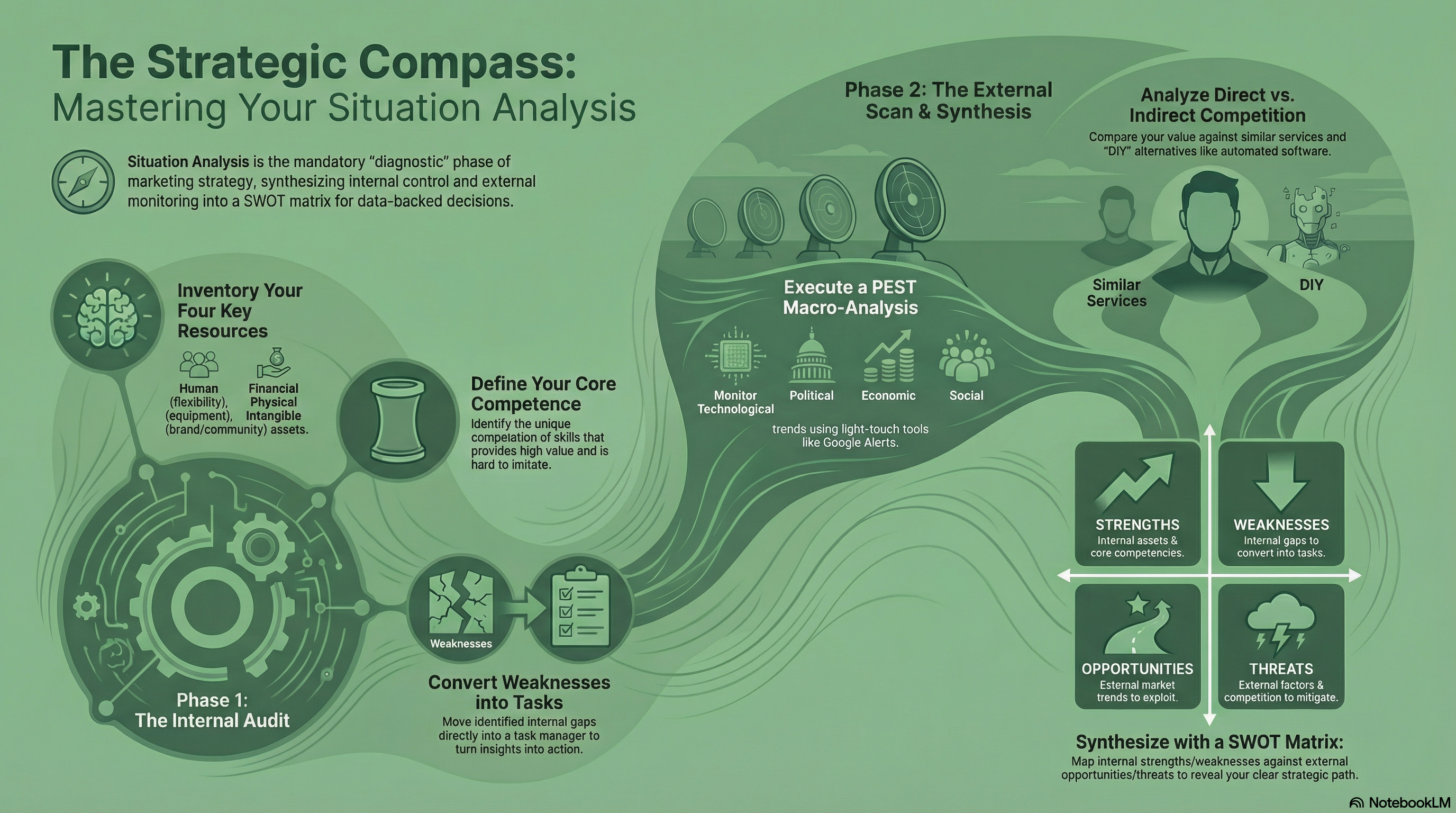
Situation analysis, Author: Dragana Jovančević (NotebookLM)
Here are the five strategic truths it reveals — and why each one will likely surprise you.
The common assumption is that your value lives in your skills and experience. But a real internal analysis goes deeper, forcing a shift from "what I can do" to "what I have." Your resources fall into four categories: human (skills), financial (capital), physical (equipment), and — most overlooked — intangible.
For freelancers, intangibles are often the most powerful assets. A personal brand on Instagram, two strong client testimonials, or a loyal niche community aren't nice-to-haves. They are strategic assets you can actively leverage. Recognizing this forces a harder question:
Once you've inventoried your assets, the next strategic layer distinguishes between resources (what you have) and competences (how you use them). A competitor might own the same laptop, use the same software, and charge similar rates. What separates you is your unique way of combining what you have.
That combination is your core competence — and it's the only sustainable defense against being commoditized on price. Vague claims of being "good" at something won't cut it. A precise statement will:
After looking inward, strategic thinking demands you look outward — at factors you cannot control but that create real opportunities and threats. This is called a macro environment analysis, often structured using the PEST framework: political, economic, social, and technological trends.
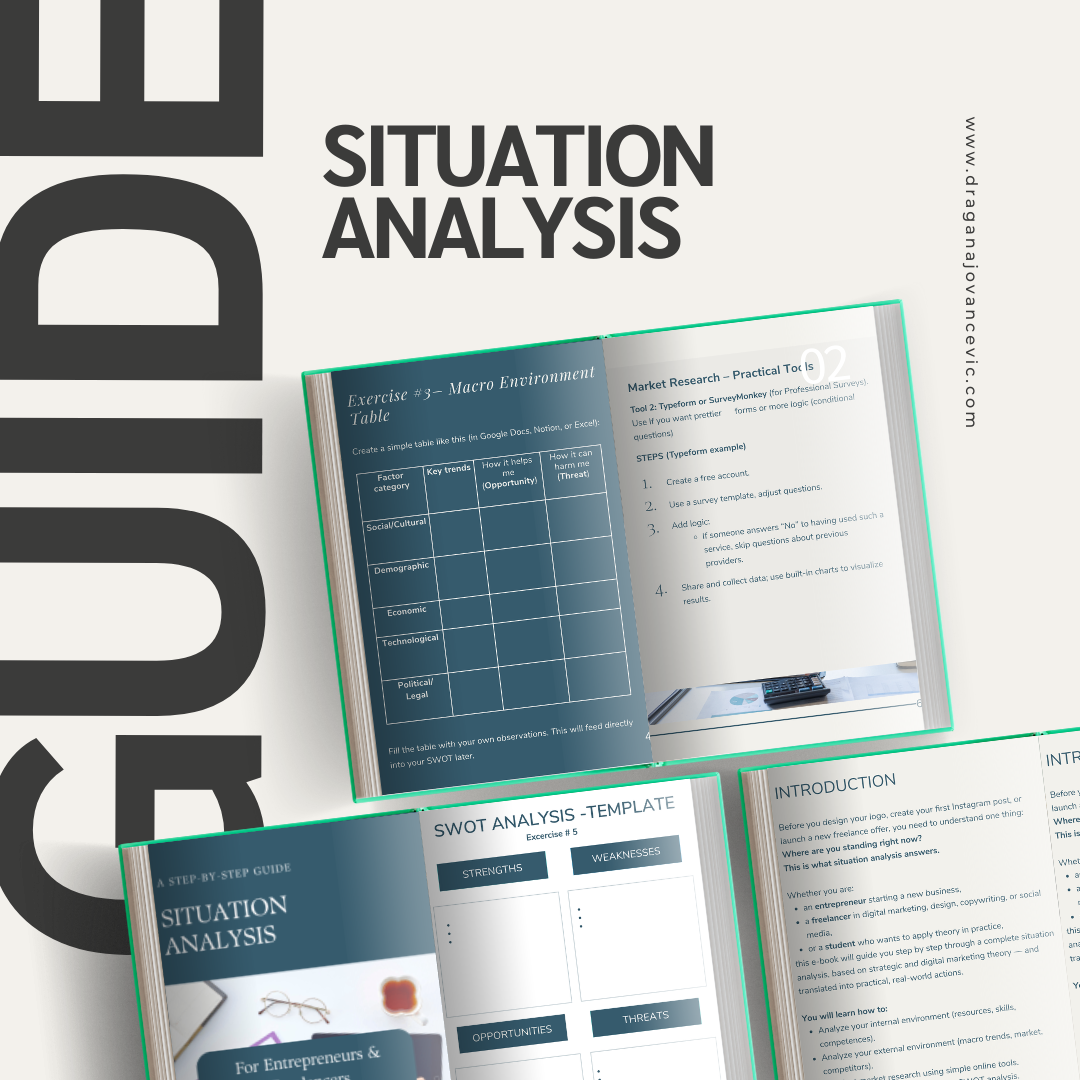
Situation Analysis Guide, Author: Dragana Jovančević (Canva)
This doesn't require a corporate research team. A simple habit — like checking Google Trends to compare rising interest in "TikTok ads" versus declining interest in "Facebook ads" — can reveal where the market is heading long before your intuition does. Consistency beats complexity here.
Most freelancers scan the market and identify competitors as "people offering the same service." That's a costly blind spot. A truly strategic analysis also maps indirect competitors — alternatives that solve the same problem, even if they look completely different.
For a designer, Canva templates are a direct competitor. They're cheap, fast, and easy for clients to use on their own. This insight is transformative. It forces you off the service-comparison battleground entirely and onto more defensible ground:
The final — and most profound — shift is moving from a frantic search for answers to the disciplined practice of asking the right questions. Market research isn't about collecting mountains of data. It's about converting a vague business problem into a specific research problem.
Consider the difference:
Business problem: Increase sales with a reduced budget.
Research problem: Identify the specific reasons preventing sales growth.
The first is a wish. The second is a mission. From a well-formed research problem, you can generate testable hypotheses — "customers are dissatisfied with response time" or "a new competitor captured our entry-level segment" — and build a diagnostic plan from there. That's the difference between hoping and knowing.
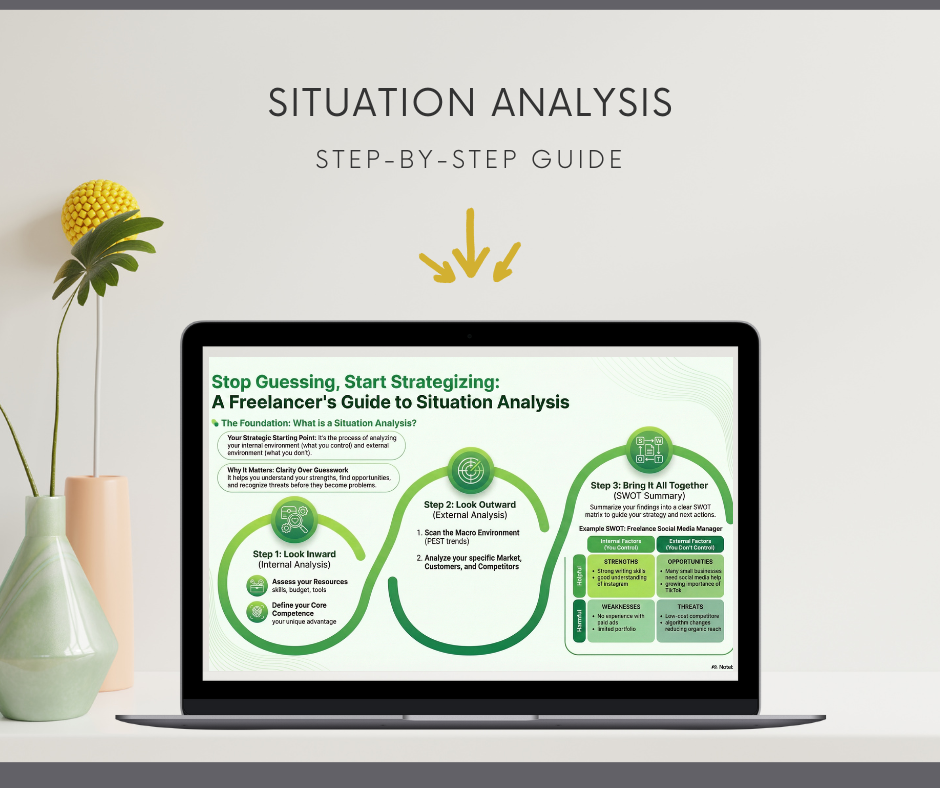
Situation Analysis in Practise, Author: Dragana Jovančević (Canva)
You build a SWOT analysis — a strategic snapshot that organizes your situation into four quadrants: Strengths to leverage, Weaknesses to manage, Opportunities to pursue, and Threats to prepare for.
Every marketing decision that follows — your pricing strategy, your content calendar, your positioning, your offer — should be anchored here, not in intuition. You don't need a large budget or a marketing department to do this. You need structure, curiosity, and the willingness to look honestly at your situation before you act.
Building a sustainable business starts with situation analysis, not action. By understanding your true assets, defining how you uniquely use them, monitoring the external environment, mapping all forms of competition, and asking the right questions — you move from hoping to knowing.
These five truths are a starting point, not an endpoint. The real work is applying them to your specific business — honestly, systematically, and before you spend another dollar on tactics built on assumptions.
What's the first thing you'll investigate about your own business?
This post is part of a series on strategic marketing fundamentals for freelancers and early-stage entrepreneurs.
How to perform situation analysis like a pro find out in: Situation Analysis Step-By-Step Guide
At Mad Brand Vault you can find a practical step-by-step guides with ready-made templates and full video courses that show you exactly how to analyze your skills, validate demand, study competitors, spot opportunities, and turn everything into a clear SWOT and positioning strategy. More about situation analysis tools you can find out here: Situation Analysis Bundle
JD Blog - Situation Analysis